Why there’s a stain but the attic looks dry
Many Tampa homes have the ductwork, and often the air handler, in the attic. So a water stain on the ceiling but no leak in the attic is often condensation: a sweating duct, a clogged condensate line overflowing its pan, or a bath fan blowing into the attic. Otherwise it’s an old leak that stopped, or a roof leak that only opens in wind-driven rain.
Sorting out which one you have before anyone comes out saves a wasted visit. An AC tech can’t fix flashing, and a roofer can’t clear a condensate line. Tampa Roofing Guys is for the roof side of that list; when the stain traces back to the AC or the plumbing, call an AC tech or a plumber instead.
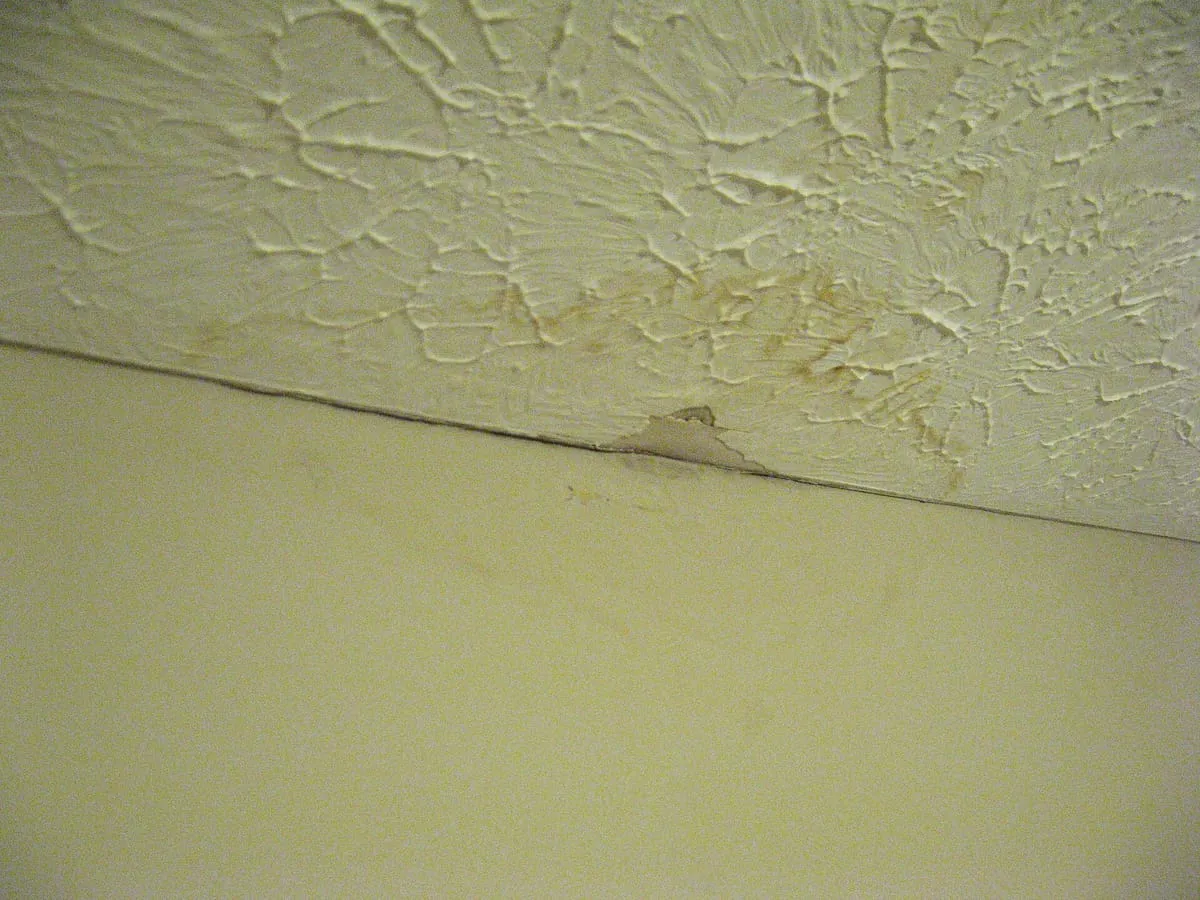 A stain alone doesn’t say whether the water came from the roof, the AC or the plumbing. Photo: Ed!, CC BY-SA 3.0.
Read the stain before you call anyone
Where the stain is and when it grows say a lot about the source. Find the row that matches yours.
| Where it is, and when it grows | Most likely source | Who to call first |
|---|---|---|
| Round or oval, around a ceiling register or a few feet from one | A sweating supply duct, or a duct boot pulled loose from the register | AC tech |
| Hallway or closet ceiling near the air handler | Drain pan overflowing from a clogged condensate line | AC tech |
| Grows in summer on hot, humid days, with or without rain | Condensation on ducts or the air handler | AC tech |
| Under or beside a bathroom | Bath fan venting into the attic, or a plumbing leak | Plumber, or whoever re-runs the fan duct |
| Along an outside wall or in a wall-ceiling corner | Flashing where a roof meets a wall, a backed-up gutter, or plumbing in the wall | Roofer if it follows rain; plumber if it’s wet on dry days |
| Only after sideways rain from one direction | A pipe boot, roof vent or ridge vent letting in wind-driven rain | Roofer |
| Unchanged for months, edges dry and firm | An old leak that has stopped | Nobody yet; mark it and watch |
Condensation: why Florida attics sweat
A supply duct carries cold air through an attic that’s hot and loaded with humidity. Anywhere the duct jacket is torn, crushed or pulled away from a register boot, that humid air hits a cold surface, water condenses, and it drips onto the back of the drywall.
FSEC researchers, in a 2017 paper for the Florida Building Commission, noted that duct sweating is most likely from July through November, when the outdoor air is moist and the air conditioner runs long hours. Earlier FSEC work summarized by the U.S. Department of Energy traced severe moisture damage in Florida manufactured homes mainly to humid air pulled in through leaky ducts in vented attics and under floors. In some of those homes the drywall was so wet researchers could push their fingers through it.
To check, go up on a hot afternoon with the AC running and look at the duct and boot right above the stain. Beads of water on the duct jacket, wet or matted insulation, or a boot that’s come loose from the ceiling all point to condensation. Sealing and re-insulating that run is AC work, not roof work.
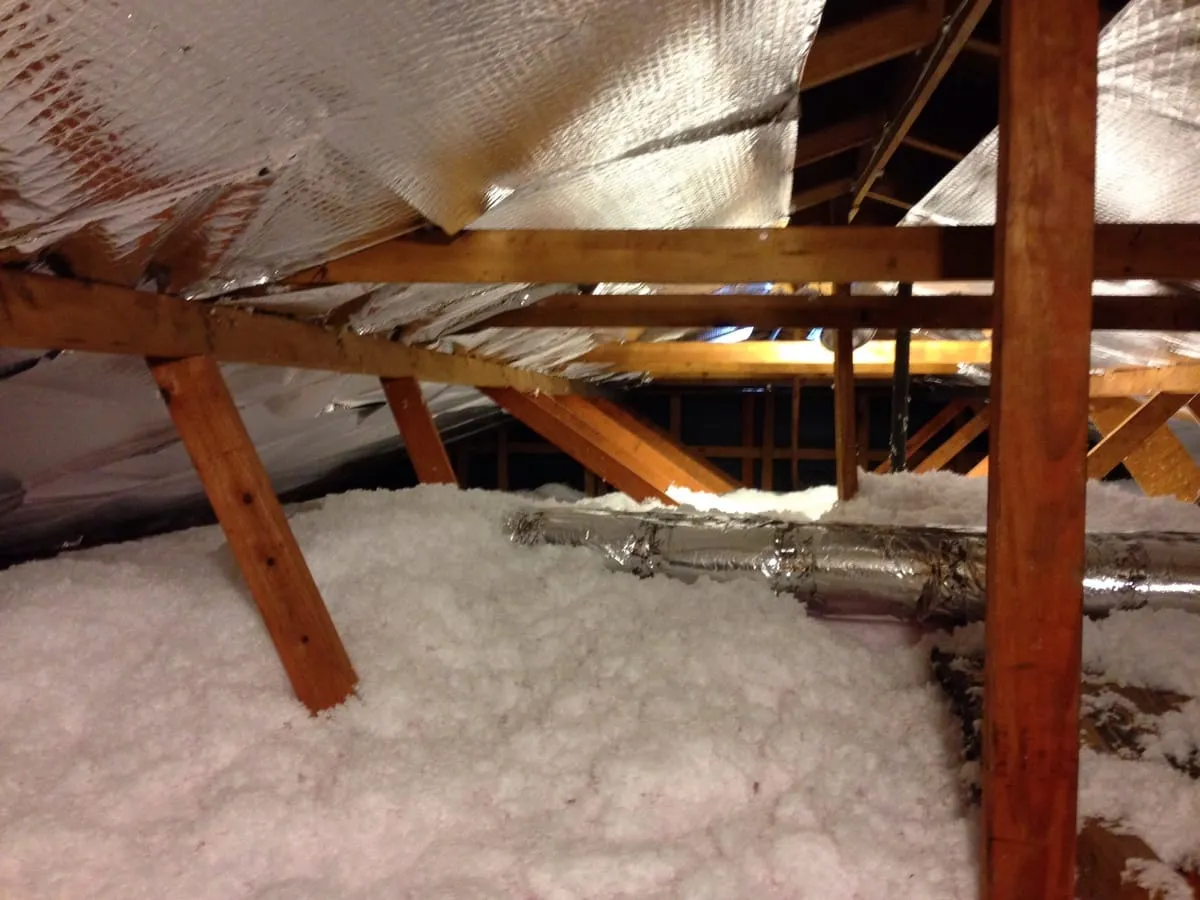 Ducts like these run through a hot attic, and a torn or loose jacket is where condensation starts. Photo: Jason Dale, CC BY-SA 3.0.
The drain pan and the float switch
Your air handler pulls water out of the air all summer, and that water leaves through a condensate line. When algae slime or debris clogs the line, water backs up into the pan under the unit. If the pan fills or has rusted through, the water goes into the ceiling.
Florida’s mechanical code expects a backup. A Florida building officials’ interpretation of FBC Mechanical 307.2.3 says a secondary drain or auxiliary pan is required where an overflow would damage the building, and that Florida doesn’t allow the option the national model code gives of putting a water-level shutoff device in the primary drain line instead.
Look for standing water or rust in the pan. If the AC quit on its own during a hot spell and came back after the pan dried, a float switch probably tripped, which means water was rising. A stain near the air handler closet plus either of those signs is an AC call.
Bath fans that end in the attic
Follow the bath fan’s duct with a flashlight. It should run all the way to a cap on the roof or an outside wall. One that ends loose in the attic, or blows toward the soffit vents, dumps warm, wet shower air right above the ceiling, and the stain shows up near the bathroom.
The fix is to extend the duct to a proper exterior cap. If that cap goes through the roof, it’s a new roof penetration and needs flashing by a roofer.
When it is the roof after all
A dry attic on the day you look doesn’t clear the roof. Some leaks only open when rain comes in sideways from one direction, and the attic dries out between storms. Building America’s guidance on flashing calls vents and other penetrations weak spots in a roof’s water control layer. FEMA’s review of Hurricane Michael found failed ridge vents let significant water into many buildings.
If the stain only grows after storms, or only after wind from one side, the roofer should check the pipe boots, the flashing at walls and chimneys, the ridge vent and any skylight above and uphill of the stain. Roof repair for leaks covers what those fixes usually involve, and the right kind of roof inspection depends on whether you also need paperwork for an insurer.
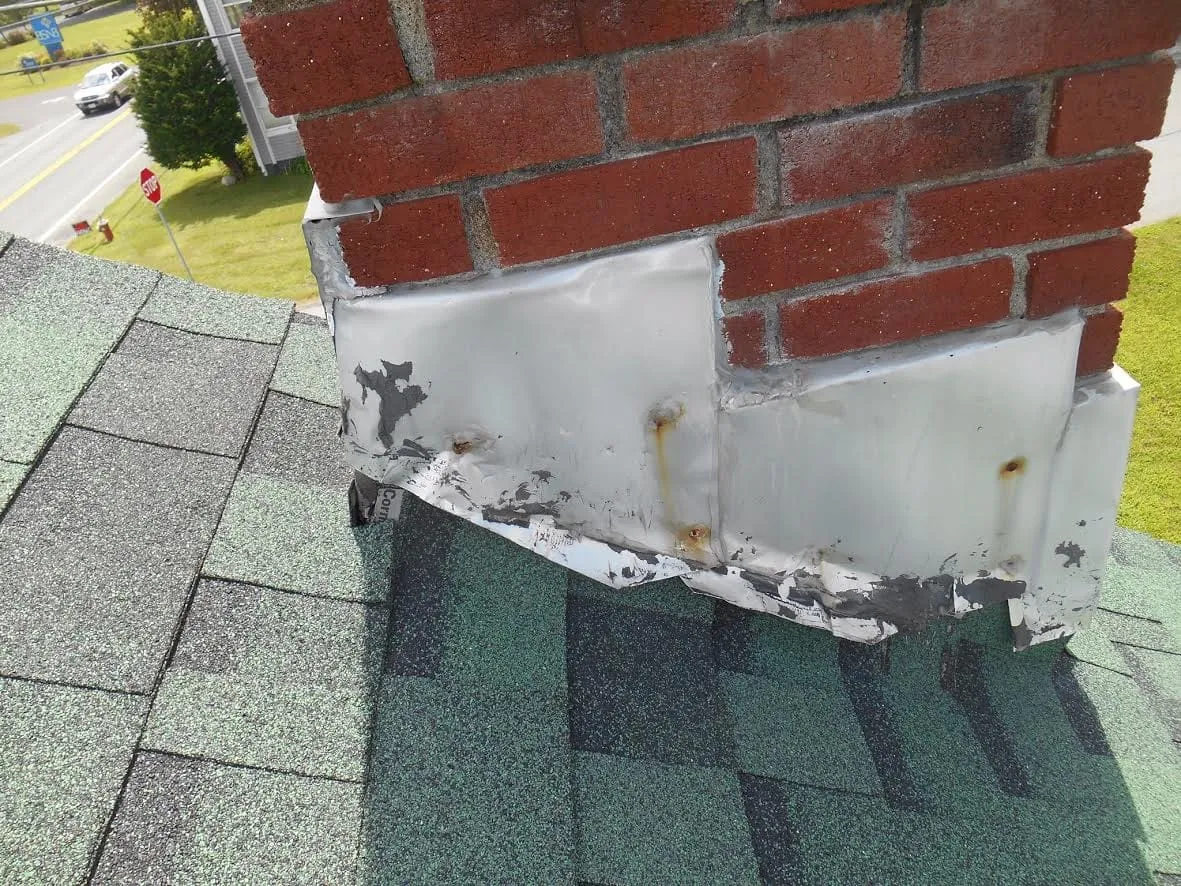 Old, reused flashing at a chimney is one of the roof spots to check when a stain grows after storms. Photo: Sandul1234, CC BY-SA 4.0.
The pencil-line test
This takes a couple of weeks and costs nothing. Trace the edge of the stain with a pencil and write the date beside it. Then watch it through two kinds of weather: a heavy rain, ideally one with wind, and a run of hot, humid days with the AC working hard and no rain at all.
If the stain spreads past the line after rain, the roof is the likely source. If it spreads on dry, hot days, look at the AC first. If it never moves, it’s probably an old stain from a problem that’s already stopped. A roofer or AC tech with a moisture meter can confirm it: a high reading on a dry day means the water is still coming from somewhere.