Water coming through the ceiling right now
Emergency roof repair in Tampa comes in two parts: a temporary cover that stops the rain, and the permanent repair once the weather clears and the insurer has seen the damage. Before you call Tampa Roofing Guys about either one, deal with the water inside.
Get a bucket or a trash can under the drip, with a towel under it for the splash. If the drywall is bulging with water, poke a small hole at the lowest point with a screwdriver. The water drains into the bucket in one spot instead of spreading across the ceiling until a whole section lets go. Then move electronics, rugs, paperwork and anything else you’d hate to lose out of the room.
Water running near a light, a ceiling fan or an outlet changes the plan. Switch that circuit off at the breaker if the panel is dry and you can reach it without standing in water. If you can’t, close the room off and keep everyone out.
Once the house is as safe as you can make it, ring and say water is coming in now, so the roofer knows to start with the tarp.
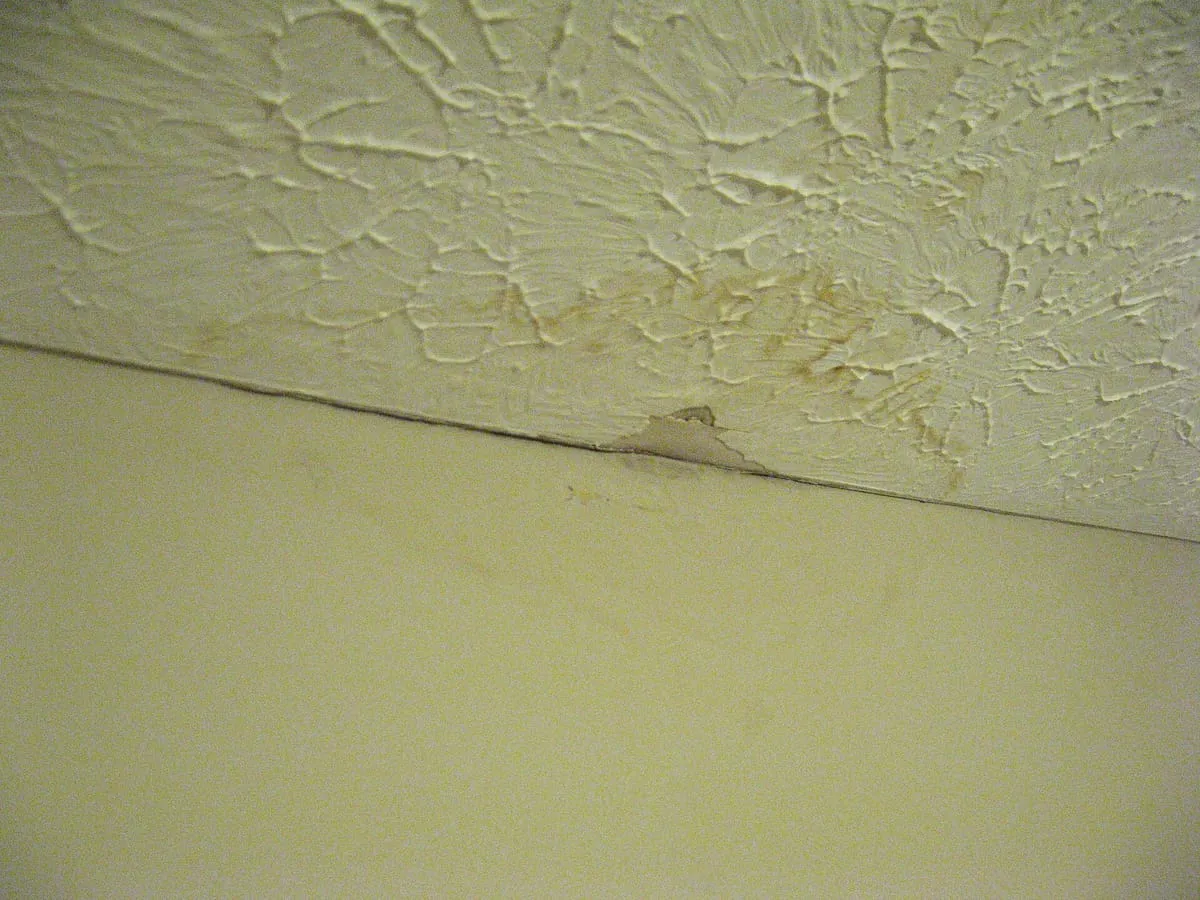 Rain getting in through the roof left this stain; once a ceiling starts dripping, get a bucket under it. Photo: Ed!, CC BY-SA 3.0.
Stay off the roof, even with a tarp in your hands
NRCA, the national roofing contractors’ association, tells homeowners to look at a damaged roof only from the ground. The fall risk is too high without the safety systems roofers use. OSHA requires fall protection for the workers who do go up after a storm, and its hurricane guidance flags wet tarps as a slip hazard. Soft decking you can’t see (the plywood or OSB the shingles are nailed to), a ladder on wet ground and fading light make it worse.
Tile roofs are worse to walk. Eagle Roofing, a concrete tile manufacturer, warns that foot traffic can crack or break tiles, so a trip up there can add broken tile to the leak you already had.
From the yard, stand back far enough to see each slope and photograph what’s missing: shingles, tiles, a hole, a limb, a tarp that’s already pulled loose.
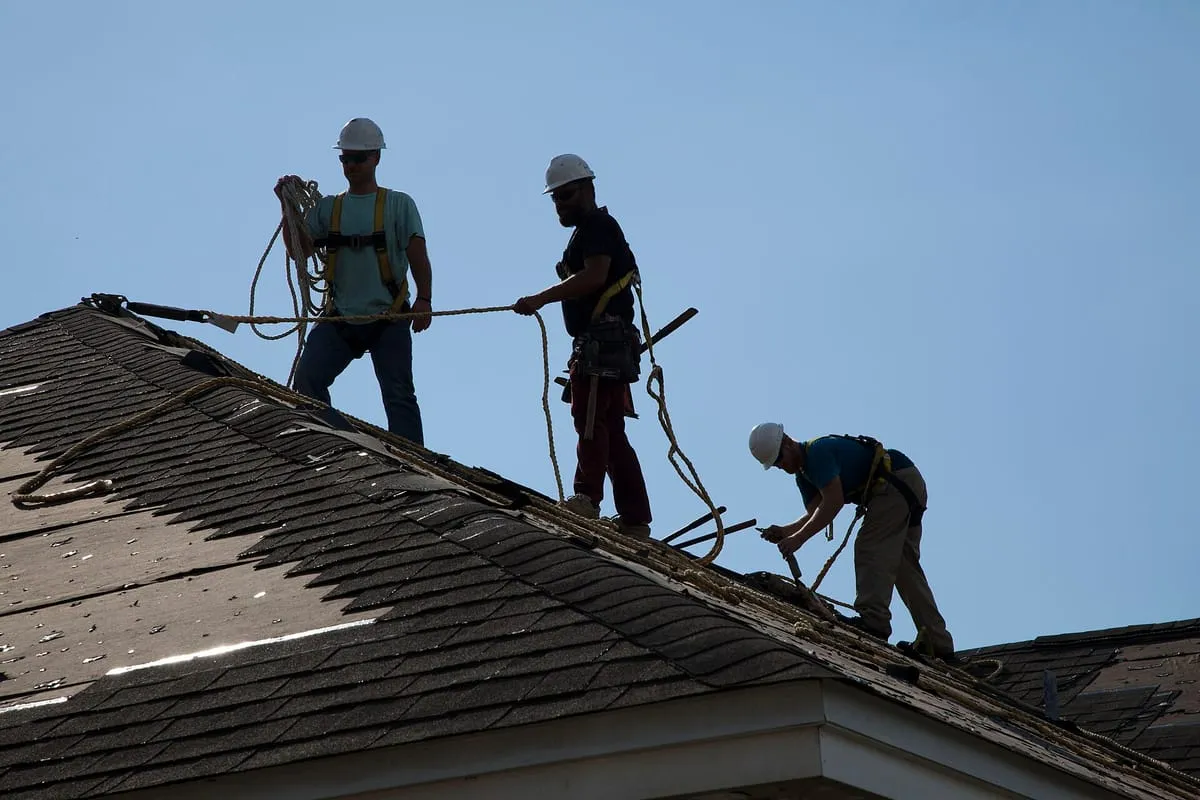 Contractors covering a roof after Hurricane Michael in Panama City, Florida, work in harnesses tied to safety lines. Photo: Patrick Bray, U.S. Army Corps of Engineers, public domain.
The first day: photos, the insurer, then the tarp
Photograph it before anything gets covered
Florida’s Department of Financial Services tells policyholders to document the damage with photos or video, make temporary repairs to stop it getting worse, and keep every receipt. It also says to let the insurer know before permanent repairs, so an adjuster can see the damage. Before the tarp goes on, get:
- every wet ceiling and wall, wide and close up
- damaged belongings, before they’re moved or thrown out
- the roof from each side of the yard
- the attic, but only if you can stand on the framing safely with a light
Write down the time you first saw water. For a hurricane, Florida law counts the date of loss as the landfall date, and the deadline to report a roof claim runs from it.
Report it, then get the tarp on
Call your insurer or agent to report the damage, and ask whether they want to inspect before the roof is covered. Then let the roofer tarp it. On most leaks, the emergency repair is heavy sheeting fastened over the damaged area so water runs off the roof instead of into it.
A tarp job should leave you with three things:
- photos of the damage before it was covered and of the tarp afterward
- an itemized invoice saying what was covered, with what, and that the work is temporary
- notes on what the roofer saw that the permanent repair will have to deal with, such as soft decking, broken tile or torn flashing
Florida law bars a roofer from handing you a repair authorization to sign without a good-faith itemized estimate. That’s one of several rules contractors work under after a storm, so get the estimate before you sign for the tarp.
Within 72 hours: emergency measures and your policy
Policies have their own wording on what you can spend to stop the damage before the insurer gets involved. Citizens policies, for example, allow reasonable emergency measures up to the greater of $3,000 or 1% of the dwelling coverage (Coverage A), unless Citizens approves more ahead of time. That can include permanent repairs needed to stop further damage. The same wording limits coverage for permanent repairs started in the first 72 hours after you report the loss, unless the company has already inspected or approved them.
On a house insured for $400,000, 1% is $4,000, so that would be the limit under that wording. Your policy may read differently. Find its section on emergency measures or temporary repairs before you pay for anything beyond the tarp. If the wording doesn’t make sense, ask your agent, or call the Department of Financial Services consumer helpline at 1-877-693-5236. The roofer can’t interpret it for you: Florida law bars roofers from interpreting policies unless they’re also licensed public adjusters.
Don’t sign for a new roof while the ceiling is still dripping
The tarp and the permanent repair are two jobs, priced and signed separately. If someone at the door wants a signature on a full replacement tonight, tell them you’ll decide after the claim is reported and you have a second written quote. After Helene and Milton, NRCA warned about contractors soliciting door to door and bids too low to be real.
Florida gives homeowners a short window to cancel some roofing contracts signed after a declared emergency, but it’s easier not to need it. Look the roofer up on the state’s license search before you sign anything bigger than the tarp.
Operation Blue Roof after a declared hurricane
After a federally declared disaster, FEMA can task the U.S. Army Corps of Engineers to run Operation Blue Roof, which puts free fiber-reinforced sheeting on damaged roofs. It doesn’t open after every storm. After Milton in October 2024 it covered Hillsborough, Polk, Pinellas, Pasco and other counties, with sign-up at blueroof.gov or 888-ROOF-BLU. The first sign-up window ran 21 days, to November 5, and was later stretched to November 14.
The Milton rules give a good idea of who qualifies:
| The house or roof | Under the Milton rules |
|---|---|
| Primary home or permanently occupied rental, under 50% structural damage | Qualified |
| Vacation rental | Did not qualify |
| Shingle, or any roof that takes nails | Qualified |
| Flat roof, or clay, slate or asbestos tile | Did not qualify |
| Metal roof or mobile home | Reviewed case by case |
A blue roof is temporary. FEMA describes the sheeting as short-term, built to last about a month, so the permanent repair still has to be scheduled and the claim still has to move.
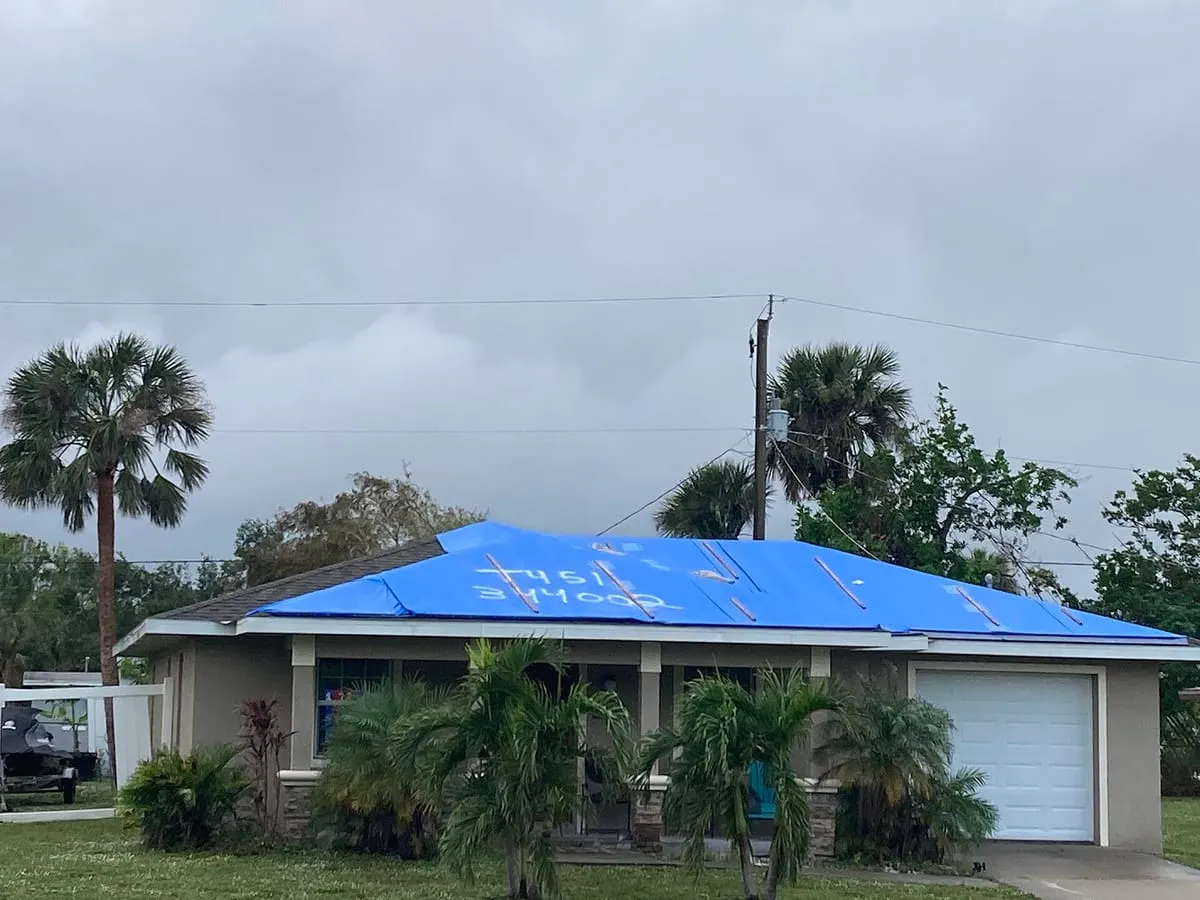 A Port Charlotte, Florida, house under Operation Blue Roof sheeting after Hurricane Ian. Photo: PCHS-NJROTC, CC BY-SA 4.0.
Can it wait until morning?
Some leaks can’t. Call now and say so if:
- water is reaching lights, outlets or the electrical panel
- the ceiling is sagging, cracking or has already come down in one spot
- you can see sky through the attic decking
- part of the roof looks sunken from the yard (why a roof sags)
A slow drip into a bucket, with the ceiling holding and the wiring dry, still needs a roofer, but nobody should climb anything during lightning to stop it. Get the tarp scheduled for the first dry window.
One more case: a stain that appears on a hot, dry day with no rain in the forecast may not be the roof at all. In Tampa houses with the air handler and ductwork in the attic, condensation and AC drain problems can stain a ceiling without a drop of rain.