Are granules in the gutters a bad sign?
Not by themselves. Granules in gutters are expected for months after a new shingle roof goes on. A steady layer of grit from an older roof, or dark bare patches on the shingles, means they’re wearing out. Grit that shows up all at once after hail or a hard wind is worth photographing before you clean it out.
When you call Tampa Roofing Guys about grit in the gutters, expect two questions first: how old the shingle roof is, and what the weather has done lately. The permit record and your own memory of the last storm usually answer both.
What the granules are doing up there
The colored granules on an asphalt shingle are its sun shield. IKO’s technical bulletin on excess granules says the asphalt has to be completely covered when the shingle is made, to protect it from ultraviolet light. Under Florida sun, that covering is what keeps the asphalt from breaking down.
Shingles leave the factory with more granules than they need. IKO calls the loose extras “hitchhikers” and says losing them in the first few years is normal and doesn’t shorten the shingles’ weatherproofing life. They collect in the gutters and fan out at the downspout outlets. Malarkey’s bulletin says that shedding can take six months to two years depending on climate.
After that, some loss never stops. Malarkey points to normal weathering and the daily heating and cooling cycle, and a Tampa roof gets a hard version of that cycle most of the year. IKO says granule loss only becomes a concern for the shingle once bare spots of the coating asphalt are exposed.
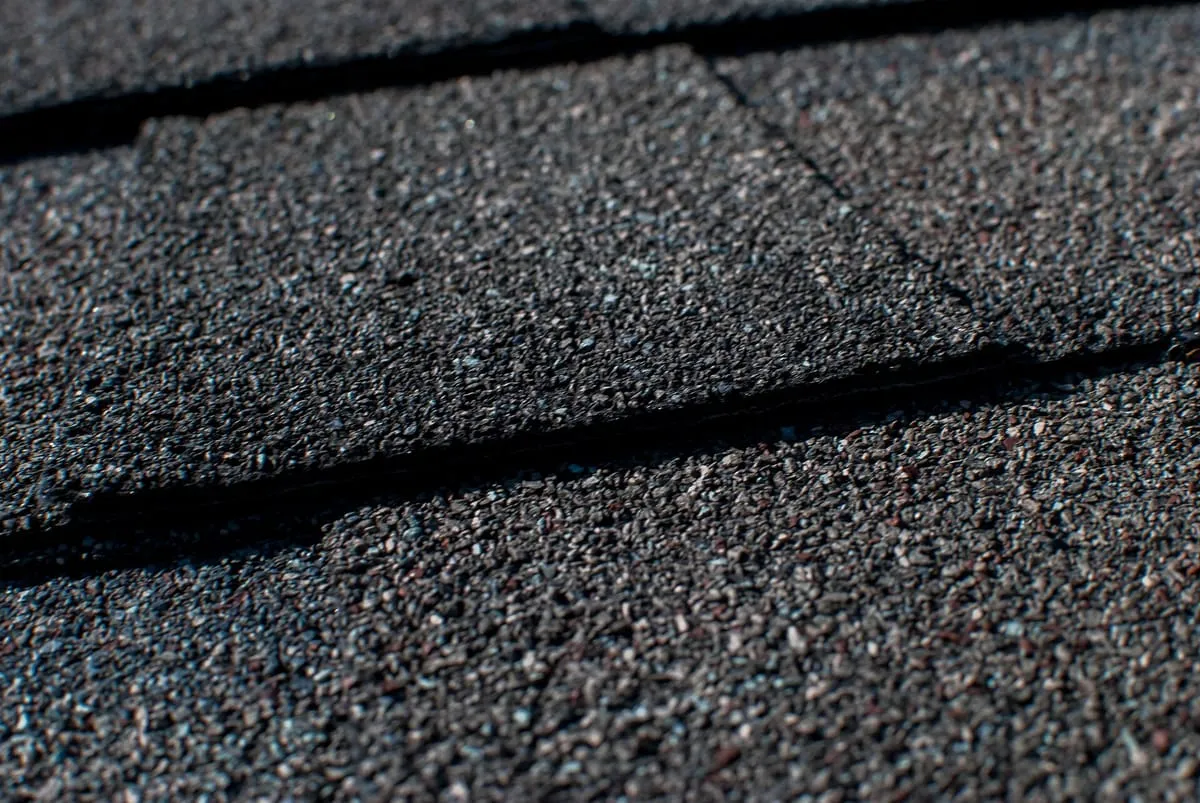 The granules are the shingle’s sun shield, and new shingles carry extras that wash off in the first year or two. Photo: Shadowmeld Photography, CC BY-SA 4.0.
Read it by the roof’s age
The age bands below are rough; the roof permit record for your address usually tells you when the roof went on.
| The roof | What you’re seeing | What it usually means | What to do |
|---|---|---|---|
| Under about two years old | Fine grit at the downspout outlets after rain, less each month | Loose extra granules from the factory | Clean the gutters and forget it |
| Mid-life, no recent storm | A little grit now and then | Ordinary weathering | Check the shingles from the ground each spring |
| 15 years or more | Grit after every rain, shingles looking patchy or blotchy | The shingles are wearing through | Get a roofer’s opinion on repair or replacement |
| Any age, right after hail or high wind | A sudden heavy load in the gutters, granules on the driveway, fresh marks on the shingles | Possible storm damage | Photograph everything before cleaning, then get it inspected |
| New roof, gutters kept from the old one | Grit that doesn’t taper off | Granules left from the old roof, which Malarkey says can sit in gutters that weren’t replaced | Flush the gutters once and watch the next few rains |
How to check the shingles from the ground
Stay off the roof. NRCA tells homeowners to inspect from the ground only, and you’ll see what matters from there.
Stand back far enough to see each slope, and use binoculars or your phone’s zoom. Look for patches that are darker or smoother than the shingles around them. On a weathered roof those patches are often bare asphalt. Look at the lower edges of the tabs too, where black can show through first.
Then judge the quantity at the downspouts. A sprinkle you could wipe up with a paper towel after a heavy rain is one thing. A layer you can scoop with your hand, rain after rain, is another. Write down what you see and the date, so next time you’re comparing against something.
Curling or split shingles, missing tabs and soft spots are separate wear signs, and together with heavy granule loss they usually mean a full re-roof is coming.
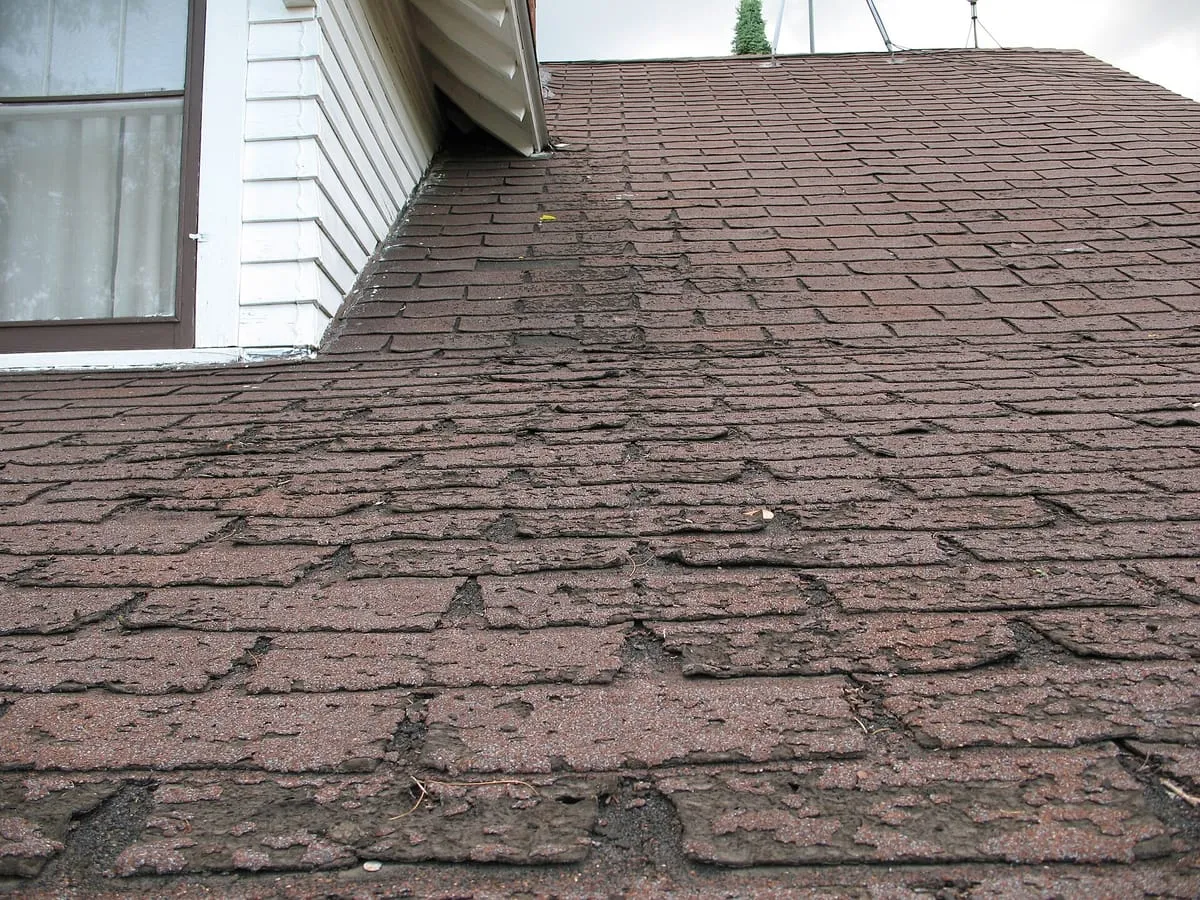 Patchy, darker areas like these, seen from the ground with a zoom, often mean bare asphalt. Photo: Dale Mahalko, CC BY-SA 3.0.
Granules after a hailstorm or a wind event
Malarkey lists high winds and hail among the things that can damage shingles and cause significant granule loss, and recommends a professional inspection after extreme weather. So a gutter full of grit the morning after a storm is a different conversation from slow loss on an old roof.
What matters is whether the shingle was broken, not only scuffed. A Haag engineer writing in NRCA’s Professional Roofing magazine explains that granule loss alone on shingles in good condition isn’t functional damage; a fractured reinforcing mat is. Expect the roofer and any adjuster to look for bruises and breaks, rather than missing grit.
Before you clean up, photograph the gutters, the downspout outlets and any granules on the ground, with the date showing. Then get the roof looked at. Storm damage and hail covers what hail marks look like and how big a stone has to be to hurt a shingle. Whether it’s worth filing is a question for your policy and your agent.
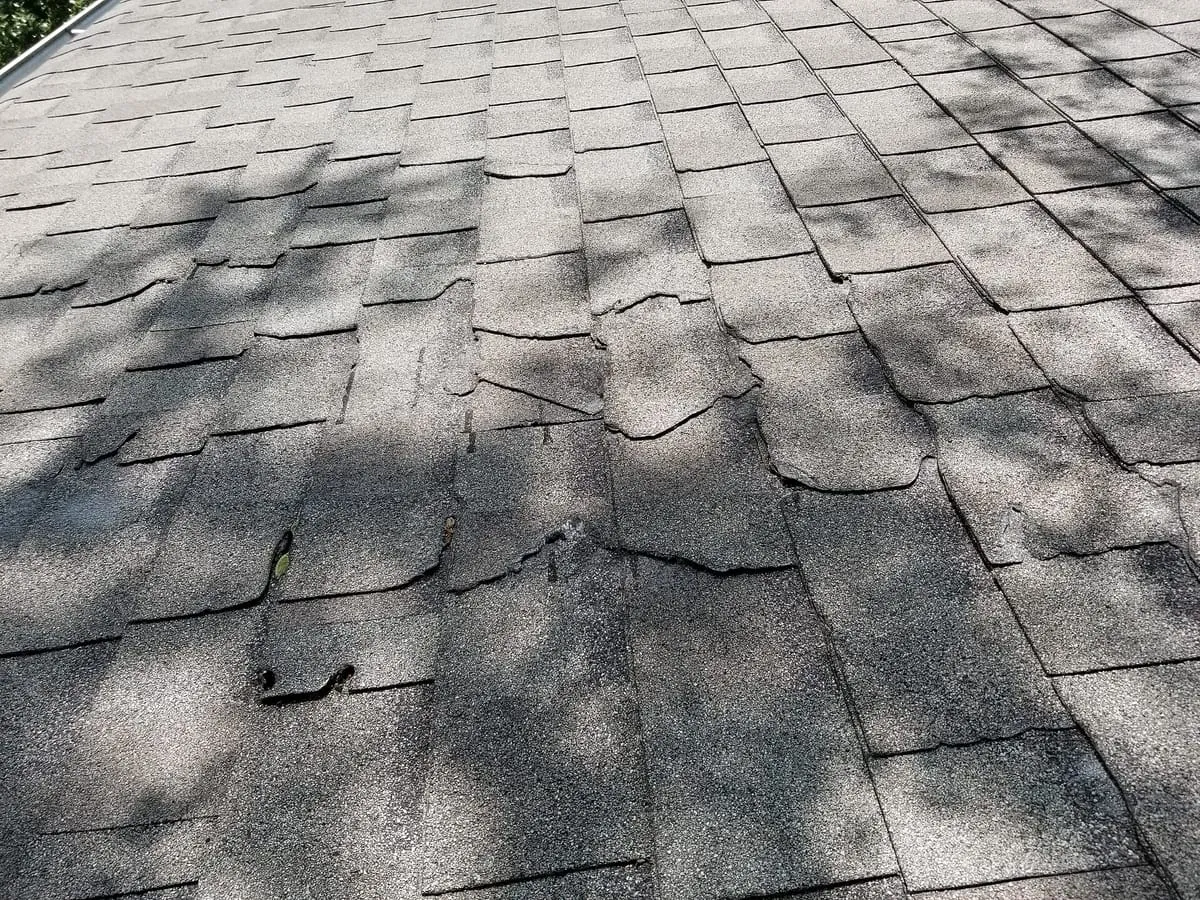 Branches that fell in a thunderstorm tore these shingles, and a break like that matters more than the grit it sheds. Photo: Samuel Bolton, CC BY-SA 4.0.
Other reasons shingles shed
Heat from below. Malarkey names inadequate ventilation alongside wind and hail as a cause of significant granule loss. If the roof is shedding hard on one side and the attic is stifling, ask the roofer to look at the soffit and ridge vents while they’re there.
Cleaning. GAF warns that power washing shingles can knock granules loose. If someone washed the roof to get the black streaks off, that may be your answer; the right way to clean algae off shingles uses a low-pressure rinse.
When granule loss means it’s time to replace
Once bare asphalt shows across several slopes, the shingles are past the point a repair can fix. The sun works on that exposed asphalt directly, and the bare patches grow. A single bald spot after a storm, on a roof that’s otherwise in good shape, is usually a repair.
Most roofs fall somewhere between those two. Ask the roofer to photograph the bare spots, say how many slopes show them, and give you a written price for both a repair and a replacement. Repair or replace walks through how roof age and Florida’s code rules weigh in on that choice.